Articles › AI Explained
How Do Self-Driving Cars See? (Explained Simply)
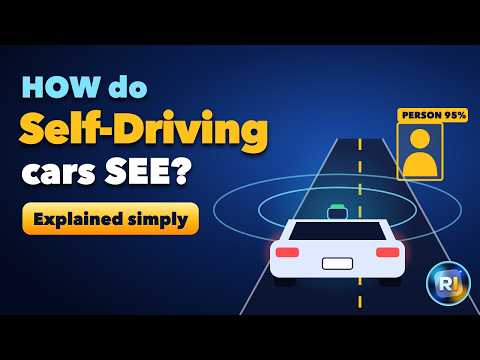
A car with no one at the wheel stops for a pedestrian, reads a red light and changes lanes smoothly. How does a machine "see" the road? It combines several kinds of sensors with AI, and repeats a simple loop many times every second. Here are the five steps.
1. Many eyes all around the car
A self-driving car usually has three kinds of sensors, each good at different things:
- Cameras see colors and detail, so they read lane markings, road signs and traffic lights.
- Radar sends out radio waves to measure distance and speed, and keeps working in rain and fog.
- Lidar fires laser pulses and times how long they take to bounce back, measuring the exact 3D shape of everything nearby.
A typical spinning lidar can capture over a million points every second, building a live 3D "dot picture" of the street. Together, these sensors watch in every direction at once. Some carmakers rely mainly on cameras, while others combine all three.
2. Making sense of it
Raw sensor data is just pixels, radio echoes and dots. AI turns it into meaning. Trained on huge numbers of labeled examples, it draws boxes around what it sees in camera images and labels them: car, person, cyclist, traffic light.
Then the car combines all three sensors into one live picture of the world around it. This is called sensor fusion. Each sensor covers the others' weak spots, for example radar helping when a camera is dazzled by the sun.
3. Where am I?
Phone-style GPS can be off by several meters, which is fine for finding a café but not for staying inside a lane. So many self-driving cars compare what their sensors see, such as curbs, lane lines, poles and signs, with a detailed map made in advance. Matching the two tells the car its exact spot on the road.
4. What happens next?
Seeing isn't enough; the car must also predict. Will that pedestrian step onto the crossing? Will the car ahead turn? Will the cyclist keep going straight? The system predicts several possible paths for everyone around it, with a likelihood for each.
5. Decide and drive
Finally, the car plans: which path to take, how fast to go and when to brake. It compares options, such as keeping speed, swerving, or slowing down and waiting, and picks the safest, smoothest one. Then it does all of this again: sense → predict → plan, many times every second.
Not every "self-driving" car drives itself
Be careful with the name. Most cars sold with "autopilot" or driver-assist features are what engineers call Level 2: the car can steer and brake in some situations, but you must watch the road and be ready to take over at all times. Truly driverless robotaxis are Level 4: they drive themselves, but only in certain areas and conditions, which is why they operate in a limited number of cities.
In short
Self-driving cars see with cameras, radar and lidar, use AI to label and combine what they see, locate themselves precisely with detailed maps, predict what others will do, and plan the safest move, over and over, every second.
Sources
Like learning this way?
New animated explainers every week on YouTube and Facebook.